
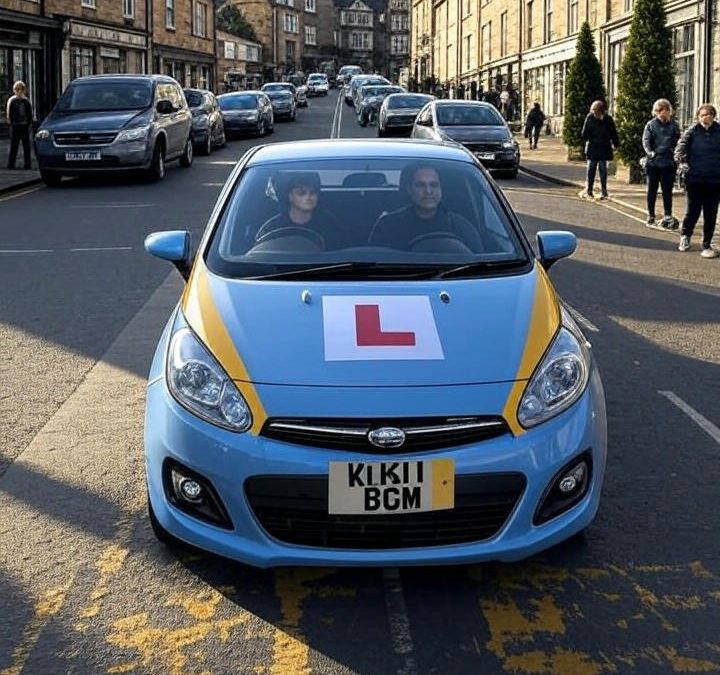
If you’re preparing for your driving test in Knaresborough, you may be wondering which roads you’ll use and which junctions you should practise.
Being familiar with the area can help you feel more comfortable. However, your examiner is assessing whether you can drive safely and independently, including on roads you don’t recognise.
DVSA does not publish its test routes. This guide covers local roads and situations worth preparing for, rather than a fixed route you should memorise.
1. Roundabouts Around St James’s Retail Park
The roundabouts near St James’s Retail Park, including those around McDonald’s, are useful places to develop your planning, positioning and judgement.
There can be several things to deal with at once: understanding your direction, choosing a lane, judging approaching traffic and identifying your exit.
Give yourself time by reading signs and road markings early. Decide which lane you need before reaching the junction, and adjust your approach speed so you can assess what is happening.
When judging a gap, look at the approaching vehicles’ speed and position as well as their signals. An indicator alone does not guarantee where someone will go.
If you realise you are in the wrong lane, avoid a sudden correction. Continue safely and follow a suitable direction rather than trying to rescue the original route.
Our guide to judging roundabouts explains this in more detail.
2. Knaresborough Town Centre and the High Street
Town driving requires you to look beyond the vehicle immediately ahead.
Pedestrians, parked vehicles, deliveries and traffic approaching through restricted spaces can all affect your decisions. A road may have a particular speed limit, but conditions can require you to drive considerably more slowly.
Look well ahead for narrowing gaps. Consider whether there is room to pass safely, whether someone may open a car door and whether you need to wait before committing.
One useful habit is to identify a suitable place to wait early. This gives you more options than driving into a narrow section and only then deciding how to deal with approaching traffic.
The aim is to make steady progress while leaving yourself time and space to respond.
3. Rural Roads Around Knaresborough
Roads around villages such as Goldsborough and Scotton provide opportunities to practise bends, changing visibility and meeting other road users.
A higher speed limit does not mean that speed will be suitable throughout the road.
Choose a speed that allows you to stop safely within the distance you can see to be clear. On narrow sections, allow for the possibility of an approaching vehicle needing the same space.
Look for clues before you reach a hazard: a tightening bend, a hidden entrance, mud on the road or a cyclist disappearing around a corner.
Reduce speed before a bend where necessary. This gives you more time to assess the road and maintain control as you travel through it.
4. Gradients and Restricted Space Around Waterside
Waterside and the surrounding roads offer useful practice in planning ahead, managing limited space and controlling the car on gradients.
If traffic stops on a hill, you need to keep the vehicle secure and move away without rolling backwards. Use the parking brake where appropriate and practise a method suited to the vehicle you drive.
Before moving off, check what has changed around you. Pedestrians, cyclists or other vehicles may have moved into the space you intend to use.
Good hill control should become a familiar part of your driving, rather than something you only practise immediately before the test.
5. Independent Driving and Following Directions
The independent-driving section currently lasts between 20 and 35 minutes. You may follow a satnav, traffic signs or a combination of both.
Keep your attention on the road. Directions help you navigate, but you still need to respond to signs, markings and other road users.
Taking a wrong turn does not automatically mean you have failed. What matters is how safely you deal with the situation. Avoid braking sharply or changing lanes suddenly because you think you are about to miss a turning.
During lessons, practise following directions without relying on your instructor to confirm every decision.
Should You Memorise Knaresborough’s Test Routes?
Knowing the area can reduce uncertainty, but memorising a route is not a reliable substitute for learning to drive independently.
Traffic, parked vehicles and road conditions change. A junction you found straightforward during one lesson may require a different decision next time.
A better question is: can you recognise what the situation needs and deal with it without help?
That includes choosing an appropriate speed, observing effectively, positioning accurately and deciding when it is safe to proceed.
How Can You Tell Whether You’re Ready?
Before your test, you should be able to complete journeys without regular reminders or intervention from your instructor.
You also need consistent manoeuvring skills, effective observations and the ability to recover calmly from small mistakes.
A mock test can help identify what still needs work. Use the feedback to guide your preparation rather than simply repeating familiar roads.
You do not need flawless driving. You do need to demonstrate safe, independent decisions consistently.
Preparing With Fantoni Driving School
At Fantoni Driving School, I use structured lessons, clear explanations and practical feedback to help you understand what you are doing well and what needs further work.
Preparation for Knaresborough includes experience of local roads alongside the skills needed to handle unfamiliar situations.
You can view our lesson prices or call or text 07912 147090 to ask about current availability. Please include your pickup area, whether you want manual or automatic lessons, and the days and times you can attend.